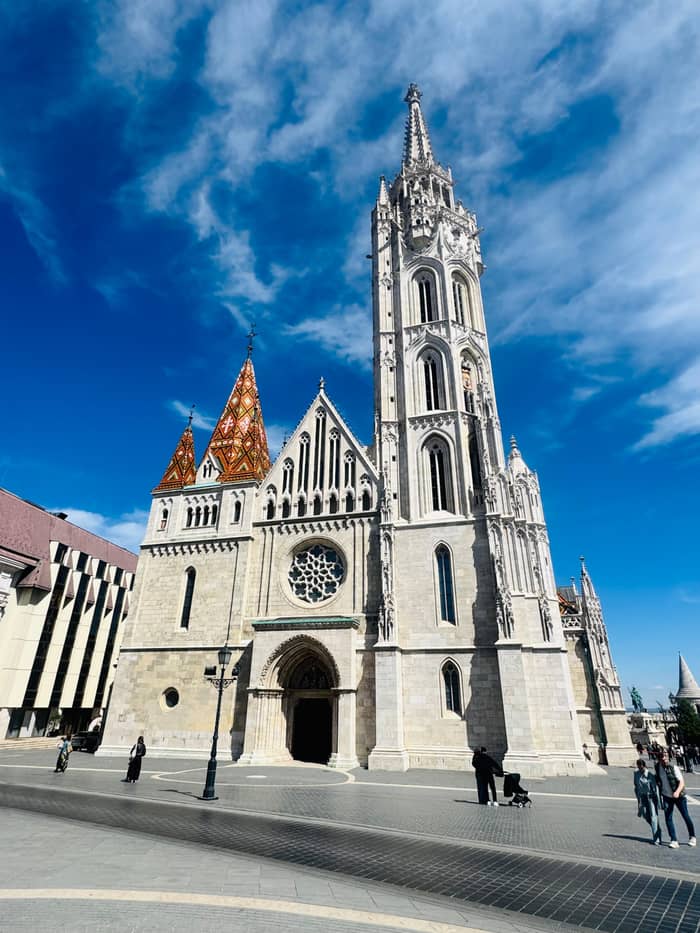
On foot
Up the stairs
A walk from the foot of the hill
- Length2 hours
- Starts atBatthyany ter
- ClimbStairs at the start
Guides
Language
Currency
Check open spots€12 and up · free cancelCost for your group
4 options compared
Pick your group size and compare walking with riding up.
≈
View≈
View≈
View≈
ViewStarting prices as on the booking platform, converted at the ECB reference rate. You see the exact price at booking.
Is Budapest walkable? Mostly yes. Here is where the hills bite, which tickets save your legs, how to avoid steps and what to know about walking at night.
Editorial team, budapestwalkingtour.click · Updated November 8, 2026 · Allow 7 min
Overview
Yes, with one caveat: the river splits the city into a hilly half and a flat half. The tourism agency puts it plainly, calling Buda the side of historic hills and Pest the livelier, more urban side, joined by the Danube and its bridges.6 The famous sights cluster near the river on both banks, and that makes them easy to link on foot.
The UNESCO-listed core gives a sense of scale. It runs along the river from Margaret Bridge to Liberty Bridge and takes in the castle district, Gellert Hill and its Citadel, and the Gellert Bath on the Buda side.7 On the Pest bank the same stretch passes the Parliament and the grand riverside facades, and you can walk it in an easy morning.
The agency also describes Hungary as safe, peaceful and easy to travel around, with crime statistics generally below the European average.1 In practice that means the main question for walkers is not safety but stamina. A tip-based tour gives a sense of the effort: around 3-3.5 km with a guide, spread over 2.5 to 3 hours.8
Tickets
| Ticket | Price | Good for |
|---|---|---|
| Single ticket | 500 Ft3 | A single ride, bought in advance |
| Bought on the spot | 700 Ft3 | When you forgot to buy ahead |
| 30-minute ticket | 600 Ft17 | Short hops with changes |
| 90-minute ticket | 850 Ft17 | Longer trips with changes |
| Block of 10 | 4,500 Ft18 | Several rides over a few days |
| 24-hour travelcard | 2,750 Ft19 | A full day of riding |
| 72-hour travelcard | 5,750 Ft19 | A long weekend |
BKK prices in forint; the funicular needs its own ticket.3,13
Castle Hill is the climb everyone faces. The funicular that has carried people up since 2 March 1870 runs on a 95-metre track and rises 50 metres, which gives a fair idea of the height you gain on foot.10,2 Its lower station sits at Clark Adam ter, on the Buda end of the Chain Bridge, next to the tunnel.9
The funicular runs daily from 08:00-22:00, leaving every 5-10 minutes on demand.11 On Mondays of odd weeks it stops for maintenance, so check before you plan around it.12 Bring a funicular ticket: the BKK funicular page states that no other ticket or pass is accepted on board, although its Budapest Card page lists the funicular among the inclusions of the 72-hour Plus card.13,14 Buses climb the hill too, and plenty of people simply walk up, as the agency notes.15
Walking up is a short, steep effort rather than a hike. One low-fare tour meets at Batthyany ter and climbs stairs for its first 7-8 minutes. Gellert Hill is a bigger climb, and the agency describes the sunset from the top as well worth the effort.16 The hills beyond, in the Buda woods, are hiking country.
Walking weather
Each month shows mid-month hours without sun and days with at least 2.5 mm of precipitation. NOAA station Budapest, period 1991 to 2020.27
Across the river, Pest is level ground laid out with boulevards and squares. Andrassy Avenue is a long, almost level boulevard, with the Opera House along the way and Heroes' Square at the far end.22 Beneath it runs the first underground in continental Europe, the second in the world after London, should your feet give out.23
Crossing on foot is a pleasure in itself: the Chain Bridge was the city's first permanent link across the river, and on certain summer days Liberty Bridge shuts to cars and fills with picnics and yoga mats.24 On the Pest side, the Duna Corso promenade is a protected stretch of the World Heritage riverside, made for slow walking.25
A practical approach is to treat the river as your spine. Walk along one bank, cross by a bridge, and return along the other. The distances are modest, the views change with every step, and you can always drop onto a tram when you have had enough. Plan the loop so the sun is behind you on the long riverside stretches, and save a bridge crossing for the evening, when the lights come on along both banks.
Your legs, your call
Describe your energy and plans, and see how to get around.
If I love walking and want to save money
Walk, with a 24-hour card
A day of unlimited rides costs 2,750 Ft.19
If I want to avoid the castle climb
Funicular or castle bus
The funicular runs every 5-10 minutes during the day.11
If I use a wheelchair
Metro line 4 and low-floor trams
Line 4 has lifts at every station; trams 4 and 6 are mostly low-floor.20,21
If I will be out late
Tram 6 and night buses
Tram line 6 runs 24/7, and night buses cover the rest of the city.4
If I want a guide without the climb
Our castle walk
It meets on top of the hill and is wheelchair accessible.
Three ways up
On foot
A walk from the foot of the hill
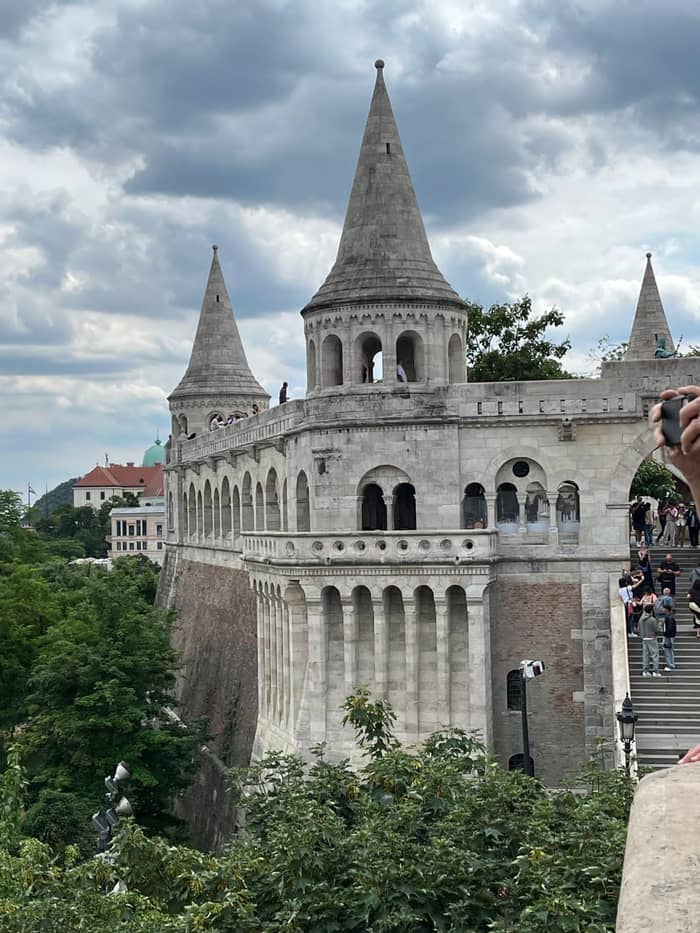
No climb
Electric hop-on hop-off
Our pick
Meets on top of the hill
The easiest way to get around Budapest is a mix of walking and public transport. BKK runs 4 metro lines and a tram network that links the important points of the center.30 For the riverside itself, tram 2 is the one to know, a ride with castle and bridge views from the window.31 Used well, transport is not a defeat for a walker: it simply moves you between the walks worth doing, so your legs last until the evening.
Tickets are simple. Buy ahead and a ride costs 500 Ft; leave it to the last moment and it costs 700 Ft.3 A 30-minute ticket costs 600 Ft and a 90-minute ticket 850 Ft, useful when you hop between lines.17 If you expect to ride all day, the 24-hour card at 2,750 Ft ends the counting.19 Buying tickets ahead saves money on every ride, and a travelcard saves you from thinking about tickets at all, which matters more than it sounds when you are juggling a map and a camera.
Validate before you ride. UK travel advice explains that on the metro you validate at the station entrance, while on buses, trams and trolleybuses you validate right after boarding.28 Keep the ticket until you leave, and validate a new one each time you change lines.32 For taxis, order by phone or app rather than hailing one on the street.33
Up Castle Hill
At the bridge
The funicular's lower station by the Chain Bridge.9
The ride
A 95-metre track climbing 50 metres.2
Or on foot
From Batthyany ter, an uphill stretch of 7-8 minutes.
Or by bus
The electric hop-on bus leaves from Clark Adam Square.
At the top
Where the castle walk this site books begins.
For a careful visitor, yes, with ordinary city sense. The agency says crime statistics in Hungary are generally below the European average and ranks the country 15th safest among 163 on the Global Peace Index.1 It adds that women can feel safe even when traveling alone.34 Is it safe to walk in Budapest at night? Stick to busy, well-lit streets after dark, as you would in any capital, and you will rarely feel out of place.
The risks are small but real. UK travel advice warns that bag-snatching and pickpocketing are common, especially in Budapest.35 The same advice mentions spiked drinks in Budapest bars: order your own and never leave a glass unattended.36 The agency adds that three-card-trick scammers still turn up on the streets, and that you cannot win.37
Getting home late is easy. Tram line 6 runs 24/7, alongside a network of night buses.4 Trams run through the night on the Grand Boulevard, and regular fares apply.38,39 Carry your passport, since police may ask for ID and a copy is not accepted.29 Keep it in an inner pocket rather than an outer bag, and keep a photo of it on your phone for your own records.
Video
Stuffed Cabbage Adventures on YouTube · Tap play to load the video; not before.
Hungary is known to be safe, peaceful and easy to travel around. Tourists can feel safe here: in Hungary, crime statistics are generally below the European average.
Before you walk
The castle district is cobbled, and the agency itself describes the Buda side as a place of cobbled streets and panoramic views.26 Wear shoes with grip and some cushioning; smooth soles slide on wet stone, and thin ones make the stones felt by the afternoon. The paid castle walk this site books goes ahead in any weather.
Summer is the hardest season for walkers. July afternoons average 28.6 °C at the city's weather station, so start early and keep the middle of the day for shaded streets, cool churches or a museum.27 A refillable bottle and a hat are worth more than any map in July. Showers are part of early summer too: June brings an average of 60 mm, so a folding jacket is worth its space in the bag.27
Winter brings the opposite challenge. January days peak at around 4.1 °C on average, and nights fall to -1.2 °C, enough for icy stairs before the sun is up.27 The tourism agency favors autumn for a visit, when warm days linger and showers are rarer than in spring.40 For long walking days, September and October are hard to beat.
Budapest is hilly, but much of it can be done without steps. On public transport, every station of metro line 4 has a lift, and the carriages on these lines are step-free.20 Trams 4 and 6 on the Grand Boulevard are mostly low-floor, and almost all of their stops are easy to use.21 Plan routes around these lines and the riverside, and leave the steepest lanes of the castle district to a bus or the funicular.
Several major sights help too. The agency notes that Parliament, St Stephen's Basilica and Matthias Church offer lifts, ramps or step-free access, and suggests asking staff for help before going in.41 Our castle walk suits wheelchair users and gathers on the summit, so nobody has to tackle the slope with the group.
Not every route suits a wheelchair or a pram. A low-fare castle walk that begins at the foot of the hill is not recommended for wheelchairs and can be hard with prams. The official electric hop-on hop-off bus on Castle Hill starts at Clark Adam Square, near the Chain Bridge, and runs from €19.
FAQ
The sights cluster along the river; only the Buda hills add real climbs.6
The funicular runs daily from 08:00-22:00, leaving every 5-10 minutes.11
Crime in Hungary is generally below the European average, says the agency.1
Validate at the metro entrance, or right after boarding a tram or bus.28
Sources
Walking Budapest soon? Ask a real person here.